Helping Others Is Important
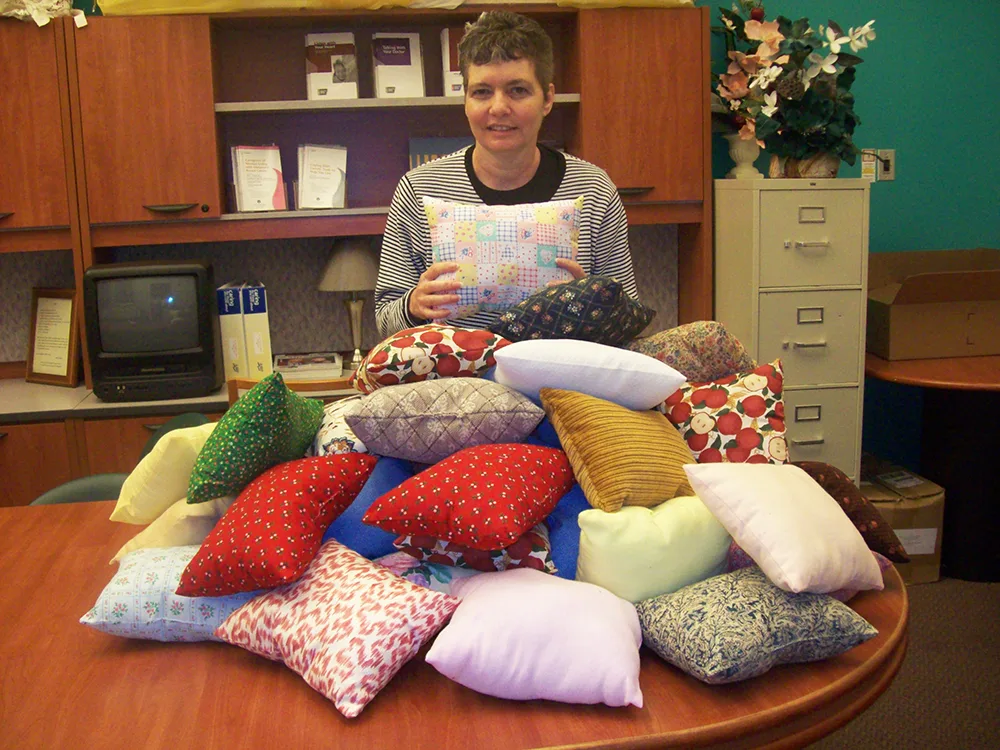
Ellen De Caro spent her career as a teacher until a brain tumor meant she could no longer spend every day in the classroom. It was important and meaningful for her to continue to take care of others, so she began making small, hand-sewn pillows for members of her community.
Listen
Transcript
My name is Ellen De Caro, and I’m 53. My diagnosis, a brain tumor. This is my fourth year, which a lot of people are thrilled that I’ve lived this long.
They tell me most people die at two years, so for four years, it’s pretty good. Uh, My book. I have a card. Helping others and moving forward. My life with a brain tumor. I know a lot of people that have gone through this. And so I talk about what happened to me. I didn’t expect it. And all of a sudden I had an attack on this side. And then I went to Hopkins and they called and they went in and they didn’t know what was wrong with me. And so they said, Put her in an MRI. And sure enough, my whole left side was black. And so they sent me to Hopkins. And they said, yeah, yours is pretty bad. And you are going to be awake from five to to nine. And I was awake the whole time. I did really well. And they were thrilled. Women were hugging me. I’m like, why are they hugging me?
But that’s true. So for, he saw it. that I may never have it. And that would have been really good. But sure enough, I went back to teaching for two years, and then I started losing my words again. And I told my doctor in September, and he said, that’s not good at all. And I said, Okay, and so he said you have to do radiation, but it was I couldn’t be a teacher again And they told me I couldn’t teach anymore.
It was important to me to care for others And so after I had my surgery I wanted to make pillows so what I do is I make the fabric and Then when I bring it to church, we stuff it and then hand sew it And so if there’s anybody at my Presbyterian Church, they would take it if somebody in the family needs it, that’s fine. If not, they all come here. I belong to a group here. We get together and I bring the bag and say, if you need it, you could take it home. And they went through the bag and they picked what they wanted. And that’s really important. It means a lot to them. And I think that’s why I’m probably advanced for four years, because I’ve, I help others, and that’s important to me.